
What happens when different types of flooding occur at the same time?
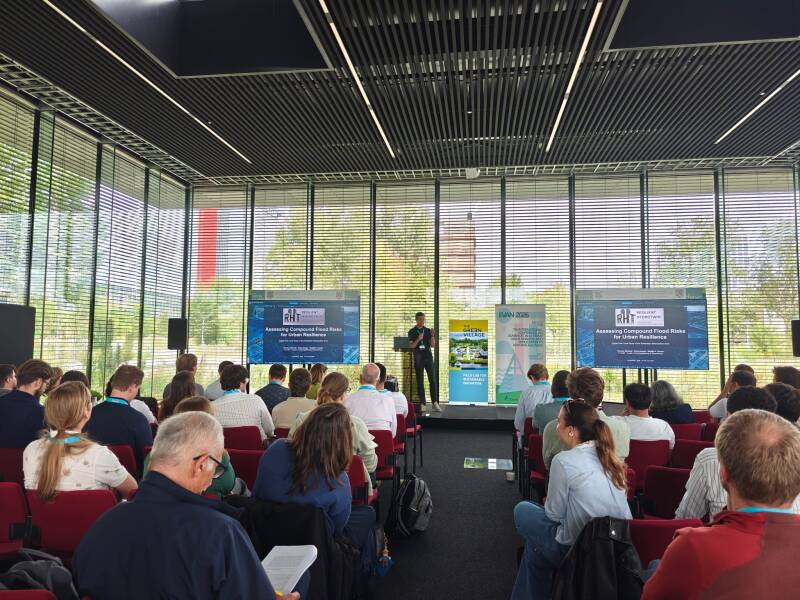
This question was at the heart of a Resilient HydroTwin contribution presented at the EVAN 2026 Conference, where Thomas Berends presented the study “Assessing compound flood risks for urban resilience: a digital twin case study of Rotterdam”, co-authored with Erica Arango and Ranjith K. Soman.
The conference brought together researchers and practitioners working on emerging challenges in natural hazards and infrastructure resilience, providing an opportunity to share new approaches for understanding and managing increasingly complex risks.
The study investigates how pluvial, fluvial, and coastal flooding can interact and change the effectiveness of adaptation and evacuation strategies in Rotterdam. Through an integrated digital twin framework, the research combines hydrodynamic modelling, building impact assessment, transport network analysis, and evacuation modelling to explore these interactions under compound flood scenarios.
The results reveal some counterintuitive effects. For example, the Maeslantkering storm surge barrier, which is highly effective against coastal flooding, can increase flood impacts when high river discharge occurs simultaneously by limiting seaward drainage. Similarly, evacuation routes that appear accessible under single-hazard conditions may become impassable when intense rainfall causes additional flooding across the urban area.
These findings highlight why understanding how hazards interact is essential for designing effective adaptation measures and emergency response strategies. By bringing these different dimensions together within a digital twin, Resilient HydroTwin aims to support stakeholders in exploring complex scenarios and making more informed decisions for urban resilience.
The presentation at EVAN 2026 provided an excellent opportunity to share these findings with the wider research community and contribute to ongoing discussions on how digital technologies can help cities prepare for increasingly complex and interconnected climate risks.